 |

|
|
Capture The Moment: FirstKnow.It
|
|
|
 |
| Methodology |
| |
|
Has it ever occurred to you that a company's share price can tell you a lot
about its credit quality? If you saw this:
|
| |
 |
| |
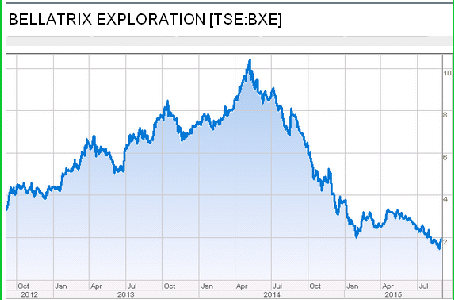
What would you think? The prospects don't look as good as they did in May
2014! Anyone looking at this graph during October 2014 should have felt concern at
the fall in the share price from $10.70 to $4.60 in just five months. Why? Well,
because the share price gives a measure of the true value of the company's
assets net of its liabilities to creditors. As the share price falls, it means
the value of the company's assets is declining and damaging its credit quality.
But was the credit quality really good in May 2014? Well, surprisingly not
really. We all know companies' share prices can go down as well as up and if
they show a lot of upward volatility they can show a lot of downward volatility
as well. A doubling of share price in just twelve months is an example of
very high volatility and the probability of a large fall is correspondingly
high. The high share price of $10.70 was good news, but the meteoric rise was bad
news because of the volatility implications - the high price could disappear
just as quickly!
The idea of using stockmarket data to derive credit information has been around
for many years and has been explored by many leading financial academics.
Evidence has also been found
that it is able to provide a more reliable assessment of companies' credit
quality than the traditional approaches used my the major international credit
rating agencies. A fuller analysis of the mathematical techniques used by
FirstKnow.It to assess credit quality is provided on our
Financial Technology page.
|
|
 |
|